










 Rod Short Rod
.
July 05, 2026
.
Drag Racer
Rod Short Rod
.
July 05, 2026
.
Drag Racer

It’s been said that you can’t teach an old dog new tricks, but that doesn’t mean that an old dog has demonstrated all of the tricks it knows. Experience, guile and cunning have won more than their share of races, even when the look is old and over the hill. Nowhere is that more evident than with the Reed and Wagenhals ’39 Chevy G/Gasser.
Some may smirk at the thought of a 75-plus-year-old race car being anywhere near interesting today, but this is one vintage Chevy that deserves a second look. In the late-’50s, Gassers were a lot closer to real street cars. Entries were required to be licensed, have working lights, wipers, factory-style upholstery, a full exhaust system and more. While some exceptions were made, these remained nothing more than hopped-up, street-legal race machines.

That began to change as the decade came to a close. NHRA divided non-supercharged Gassers into eight different classes based upon the total car weight divided by the total cubic inches of engine displacement. G/Gas became the home of in-line six-cylinder engines along with pre-1960 flathead V-8s and four-bangers with weight breaks ranging from 5-10.99 pounds per cubic inch. This was one of the slowest and least expensive Gasser classes, and thus the most competitive with plenty of entries crowding the staging lanes. Six-cylinder Chevys from 1937-39 were popular in this class.
“Bullet” Bob Reed was one of those early Chevy Gasser pilots, driving his ’39 model to a class win at the U.S. Nationals, and then into the thick of the A/Factory Experimental wars in 1965 with a Hemi-powered A990 Belvedere. When Mopar changed gears to go Stock/Super Stock racing in 1968, Bob was there with one of the original 50 BO29 Plymouth Barracudas. Bullet Bob was always one of the fastest Hemi ’Cudas on the planet and won the coveted, prestigious SS/AH class shootout (now known as the Mopar Hemi Challenge) at the 1987 U.S. Nationals. That was followed by an NHRA SS/A speed record at 153.71 mph while running an 8.82. In later years, he teamed with his friend Ronnie Sox barnstorming around the country to the delight of fans everywhere. He still runs his Hemi ’Cuda at various match race events today.

Several years ago, Bob decided to resurrect the memory of his original Chevy Gasser. His partner in this project is Fred Wagenhals. Both men hail originally from the Marion, Ohio area. Fred is the .founder and driving force behind the group of Action Performance Companies, Inc. He gained recognition for two-man jet pumped boats, 1⁄3 scale gasoline mini-cars and the mechanical bull seen in the ’80s movie “Urban Cowboy.” Seeing the potential for diecast racing collectibles, Fred got into the business by selling his home to secure exclusive property rights for Dale Earnhardt. Yet, even as NASCAR became responsible for the majority of his business income, he never forgot drag racing.
In keeping with the tradition of their Gasser roots, Bob and Fred went with a L25 292-ci in-line six, which was found in many Chevy and GMC trucks from the ’70s. Some readers may recognize this engine as the basis for the Cotton Perry & Jim Headrick Chevy II that won four NHRA Division 2 championships and nine national events in the old Modified Production class. Noted six-cylinder engine builder Mike Kirby of Sissell Automotive built the combination with an original block bored .040 for a final displacement of 298 ci.

The reciprocating assembly is made up of a stock crank with seven main bearings, GRP aluminum rods and J&E 15:1 pistons. Enderle did the entire fuel induction system from the sheet metal intake up to the injector hat. When photographed at the track, Bob was experimenting with a single 4bbl carb setup but has since returned to the Enderle injection system. Outlaw Headers assembled the tubular exhaust. When dyno’d, the little stovebolt produced 576 peak horsepower at the flywheel with 470 ft-lbs of torque.
Behind the engine is a G-Force five-speed, which Bob uses to launch the car at 6,000 rpms. A Strange 9-inch rear with 5.67 gearing is used with Competition Engineering suspension components. Goodyear slicks provide hook.
“Fred and I were partners back in the fifties when we street raced,” Bob said. “We won class at Indy together back in the very early sixties with a 1939 Chevy like this. When people heard we were building a tribute to that old car, they laughed and then told me I was crazy when I said I thought it could run 6.50s in the eighth. Well, it ran a 6.80 on its first pass and then a 6.50 just the second time down the track. Later on at Bakersfield, it ran a best of 10.10 at 128 mph in the quarter. Enderle just built a high-speed bypass for me to use, so, in my mind, it still has the potential now to run some 9.90s.”
With potential like that, it looks like this old dog is plenty tricky!
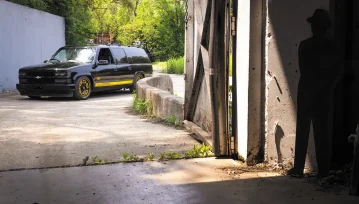
Chevrolet
A Major League Find Hello dear OBS Builder’s Guide readers, Emma from Mobsteel/Detroit Steel Wheel here, and yes, we are talking about our Detroit Steel… Continue reading
Emma Sauve Emma Sauve . July 16, 2025

Feature Stories
2017 Ford F-150 Raptor LET’S GET ONE THING OUT OF THE WAY: THE ALL-NEW F-150 RAPTOR IS ANYTHING BUT A STREET TRUCK. With nearly 2… Continue reading
AARON GOLD . January 06, 2026

Drive Online
Did you notice? General Motors has always been an innovator when it came to classic car styling starting way back from the 1940s all the… Continue reading
GREGG OVIST . July 22, 2024
Events
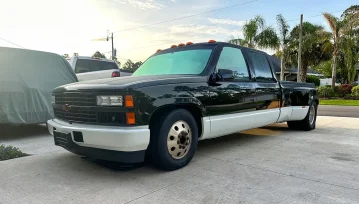
Finishing the Dually and Taking it on the 2023 Hot Rod Power Tour I’m in the home stretch of this dually build and the 2023 Hot… Continue reading
Josh McPherson . September 26, 2024
F Series Builders Guide
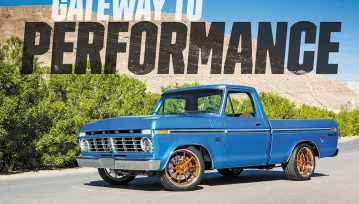
Making a Dent in the Scene When discussing the Ford F-100, most conversations lead to the mid-’50s body that has been done successfully time and… Continue reading
MIKE ALEXANDER . August 22, 2023
F Series Builders Guide
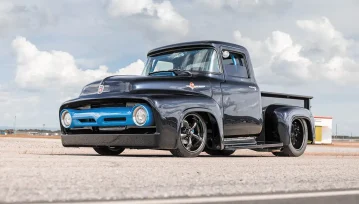
Nathan Thomas’ 1956 Ford F-100 Pro Street Dream There’s just something about an old-school Ford that never goes out of style. For Nathan Thomas of… Continue reading
Joe Greeves . November 11, 2025

Goodguys 28th Griot’s Garage Colorado Nationals
The Ranch Events Complex 5280 Arena Circle, Loveland, CO 80538
Elks Auto Show
Elks Auto Show 1140 Umpqua College Rd. Winchester OR. 97470
The Sparks Show
Sevierville, TN
Goodguys 36th Autumn Get-Together
Alameda County Fairgrounds 4501 Pleasanton Avenue, Pleasanton, CA 94566
Goodguys 29th Speedway Motors Southwest Nationals
WestWorld of Scottsdale 16601 North Pima Road, Scottsdale, AZ 85260




 Please wait...
Share Link