










 Rod Short Rod
.
July 05, 2026
.
Drag Racer
Rod Short Rod
.
July 05, 2026
.
Drag Racer

When Shakespeare wrote, “Uneasy lies the head that wears the crown,” the reference was to King Henry IV and the burdens that accompanied him on the throne. For some years, many a nitrous and supercharged Pro-Mod-style team has felt those same burdens as they’ve wrestled with the onslaught of turbocharged competitors. The current concern is how turbochargers will influence the future of racing. To get the full story, it’s necessary to understand their history and how the sport has adapted in response to their use.

Turbochargers have a longer history in drag racing than many realize. Chevrolet offered a turbocharger option in 1962 with the Corvair, as did Oldsmobile. Drag racers were fairly quick to realize the potential of running a turbocharger combination and experimented with it in several different classes. Dick Griffin was a winner in B/Stock with a flat six turbo Corvair in 1965, which he reported was running in the low 13-second range. The same year, Bud Faubel ran developmental tests with a twin turbo Hemi combination. Jerry and Gary Mallicoat ran a turbo on their ’40 Willys in the early ’70s. “Ohio” George Montgomery won the Gatornationals with a similarly boosted Boss 429 combination. Gale Banks and Gene Snow experimented with turbo Top Fuelers, while Buddy Ingersoll terrorized Pro Stock with a Buick Regal before he was ruled out of the class.
The aftermarket industry has embraced turbos by designing more parts to meet the needs of this specific power adder.

In later years, turbochargers gained a stronger foothold in drag racing within the various street car and sport compact series. Today, they’re much more mainstream. In just the second half of 2015 alone, turbo cars continued to break barriers. In NHRA-legal Pro Mod, which has the best balance of rules between nitrous, blown and turbo entries, Don Walsh’s 5.774 at 259.66 with a 1.018 60- foot time at Vegas was the fastest pass of the entire year. Remembering how out-of-the-ordinary performances like this can earn a lead trophy, Walsh backed off when he later won the opening round of eliminations with a 5.876 with an off-the-throttle 216.83, then redlit in the next round. At the year-end Street Car Super Nationals in Vegas, Australian Paul Mouhayet ran an impressive 5.655 elapsed time to qualify first. Troy Coughlin was right behind him with a 5.597 at an even more stunning 274.83 mph. You can bet tongues were wagging during the off-season.

Turbocharged cars were once considered more Outlaw than not and were forced to make do with parts and pieces designed for other applications. Even though the rules were inadequate to police turbo technology, research and development was lacking, which resulted in many turbo cars being rather inconsistent and unable to reach their full potential. Today, however, the aftermarket industry has embraced turbos by designing more parts to meet the needs of this specific power adder.
On first examination many turbochargers and their ancillary products look much the same, but the truth of the matter is that they are improving.

Electronics have undergone the most significant development, with the most important changes occurring in the past 10 years in regard to increased microprocessor speeds. Electronic fuel injection, which evolved from being more street car emissions systems, is now much more race oriented and even platform specific. These developments have created the need for a new breed of tuners who may not even get their hands dirty. An example can be found in fuel and ignition tables, which are different for spool-up and wide-open-throttle engine demands. Microprocessors can switch back and forth between these tables without any loss in performance. Another example can be seen in the data logging and diagnostics incorporated into many EFI systems, which now are often standalone units in order to provide a series of checks and balances against what the EFI system is doing. Electronic boost and ignition timing controls alone have done much to tame the wild turbo beast for better on-the-track results. Throw in some other wild cards and one quickly realizes how a well-tuned turbo car can be one of the most complicated vehicles on the drag strip.

An example of how complex these cars have become is fact that chassis designs have evolved to accommodate turbochargers. On some NHRA Pro Mod cars inquiring minds might realize that the top frame rails sometimes have larger diameters and are placed farther apart to provide a structurally stronger chassis. One car is even using three frame rails. Wheelbases are sometimes stretched to the max at 115 inches, while other cars in the same class are considerably shorter. Torque converters are now more closely matched to the power band.

So what does the future hold? Turbochargers will continue to evolve and possibly enter the mainstream. On first examination many turbochargers and their ancillary products look much the same, but the truth of the matter is that they are improving. Several leading-edge manufacturers gave us some examples.
“Our patent-pending, adjustable compressor cover inlet is tunable to an engine’s specific characteristics,” said Bill Devine of Bullseye Power. “This allows the turbo to better match the airflow characteristics of a particular engine. We all know the same turbo performs differently on different cubic inch sizes and particular designs, such as pushrod, rotary and modular engines. This provides a tuning solution to help equal the playing field, similar to experimenting with valve lash, ignition timing, fuel or shocks to help make the most of your combination.”


With boost control, Turbosmart’s newest product points to what the future holds. Its new e-BoostHP electronic controller can manage boost based on different parameters such as gear, rpm, elapsed time or auxiliary inputs such as methanol or nitrous injection. The debut of this product was so impressive that it won SEMA’s Runner-Up award for the Best New Street/Performance Product.
Many of the early turbos for street cars were actually taken directly from farm tractor and industrial applications. BorgWarner’s EFR (Engineered For Racing) line of turbochargers has changed that with a number of innovative technologies. Patent-pending dual ceramic ball bearing cartridges and low-weight Gamma-Ti turbine wheels for quicker spooling, and stainless steel, rather than cast iron turbine housings, all make this line of units that support 225-to 1,000-hp per turbo particularly attractive.
We’re also finally seeing a shift from individual-component-only outlets to complete one-stop-has-it-all suppliers that offer all of the hardware and software items needed for success on the track.

“We’ve continued to make our mark in the aftermarket turbocharger market for three reasons,” said Joe Krivickas, sales manager of Precision Turbo. “Our customer service, exclusive turbocharger designs and ability to sell and support a complete turbocharger/EFI package sets us apart. Our proprietary bearing systems, as well as aerodynamic designs, give us a competitive advantage with improved performance and durability at a competitive price. We have the right people, and the right parts to provide the complete package.”
There’s no doubt about it, turbocharged race vehicles are here to stay. As they continue to become standard equipment in production street vehicles, one can only expect to see them expand into other competition classes as well.
Borg Warner
Turbos.bwauto.com/en/aftermarket/efr.aspx
828.684.4030
Bullseye Power
Bullseyepower.com
231.788.5209
Hyperaktive Performance Solutions
Hyperaktiveps.com
847.321.1982
Precision Turbo & Engine
Precisionturbo.net
855.996.7832

Chevrolet
One Guy’s Search for a Quick Fix One of the toughest aspects of a build of any magnitude is time management. You can plan all… Continue reading
John Mata Jr. . February 24, 2026

Feature Stories
Keeping the Mini-Truck Scene Alive Trends are one thing, but styles are a different story all together. It’s rare that what’s popular today will be… Continue reading
Mike Alexander . February 04, 2026

C10 Builders Guide
This 1972 Chevy Restomod C-10 Packs a Punch LOT OF CUSTOM truck enthusiasts tend to wax pretty nostalgic about our high school years when life… Continue reading
BOB RYDER . March 04, 2026
Chevrolet
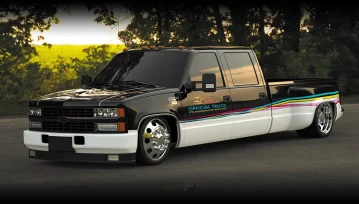
GETTING STARTED ON THE 1993 SILVERADO C3500 DUALLY I have always wanted a cool tow rig for my projects, and I have always wanted an… Continue reading
JOSEPH DOWLING . July 26, 2023
Feature Stories
A quiet revolution is happening in garages and workshops all around the world right now. Specialists and EV enthusiasts alike are opening EV conversion shops… Continue reading
Motortopia Staff . February 20, 2025

Drag Racer
The Big Go Just Keeps Getting Better With Age NHRA threw a birthday party for its premiere national event for these past 60 years and… Continue reading
Pete Ward . July 05, 2026

Goodguys 28th Griot’s Garage Colorado Nationals
The Ranch Events Complex 5280 Arena Circle, Loveland, CO 80538
Elks Auto Show
Elks Auto Show 1140 Umpqua College Rd. Winchester OR. 97470
The Sparks Show
Sevierville, TN
Goodguys 36th Autumn Get-Together
Alameda County Fairgrounds 4501 Pleasanton Avenue, Pleasanton, CA 94566
Goodguys 29th Speedway Motors Southwest Nationals
WestWorld of Scottsdale 16601 North Pima Road, Scottsdale, AZ 85260




 Please wait...
Share Link