










 Amit Kumar
.
July 05, 2026
.
Drag Racer
Amit Kumar
.
July 05, 2026
.
Drag Racer
IN PART 1 OF OUR TRIBUTE TO THE 50TH ANNIVERSARY OF THE FUNNY CAR, DRAG RACING HISTORIAN “200-MPH” DAVE WALLACE EXPLAINED THE GENESIS OF THE BREED FROM FACTORY SUPER STOCKERS TO ALL OUT, NITRO-BURNING, ALTERED WHEELBASE MATCH RACERS, OR “FUNNY CARS” AS THEY QUICKLY BECAME KNOWN. The mid-’60s, 1964 and 1965, were years of experimentation, an anything-goes period. The end result was the release of Chrysler’s radically altered wheelbase A/FX cars, which were quickly followed by a slew of highly modified Ford, Lincoln-Mercury and GM privateer entries fielded by some of the top names in drag racing. However, as Wallace pointed out, Funny Car racing as we know it actually began with the Supercharged Experimental Stock, or S/XS, entries fielded in 1964 by the Dodge Chargers (Jim Nelson, Dode Martin, Jim Johnson and Jimmy Nix) and Jack Chrisman’s awesome ’64 Mercury Comet.


Where to go from there? Credit hot rod pioneers Gene Mooneyham, Jack Chrisman and Lincoln-Mercury Division’s Drag Racing Team captain, Al Turner, for coming up with the concept of a drag racing vehicle that looked the part of a stocker, was part altered, part fueler and all Funny Car. Turner recalls how it all got started.
“We took all the development work that went into Chrisman’s [1964 and 1965] Comet programs and used it on the flip-top Comets. Jack and I were sitting around Gene Mooneyham’s garage one day and we were talking about the Chrysler cars moving their wheelbases forward and all. By that time, the executives at Lincoln-Mercury Division were starting to complain about the fact that all comparisons to the base model Lincoln-Mercury product were becoming lost. If we continued in that direction, we would soon be facing a real marketing problem. After all, we were in the business of selling cars. We realized that if we changed these cars to the degree that they looked goofy, you had lost all comparison to the cars you sold off the showroom floor, so why do it?”


At this juncture, Turner turned to Mooneyham as if to validate an idea that he and Chrisman had been kicking around over coffee and asked, “Gene how fast did you run with the Mooneyham & Sharp 554 coupe? What was it, 160 mph?” Chrisman’s ’64 and ’65 Comets had also run that fast with a blown motor in a stock body. Based on that conversation, Turner’s proposal to the board at Lincoln-Mercury Division was fairly straight forward and simple, although L-M’s Director of Racing, F.A. “Fran” Hernandez, initially thought Turner completely crazy.
“I went out and bought one of those AMT three-in-one plastic model kits and built a matchstick frame. Then I put the body over the frame, and that is what I presented to the board at L-M. It was that simple!” Hernandez remembers.


Once approved, Logghe Stamping Company won the contract and Team Mercury rushed four cars into production for drivers Chrisman, “Dyno” Don Nicholson, “Fast” Eddie Schartman and Kenz & Leslie. Logghe devised a simple dual-rail ladder-type chassis following Turner’s matchstick model that featured coil-over sprung suspension on all four corners (a first for Funny Cars) with a basic cage to protect the driver. They were powered by 10.75:1 compression 427 SOHC Mercury cammer engines sporting Crane Cams valve trains, Hilborn fuel injection (Chrisman’s Comet was GMC supercharged) running on 80% nitro and developing 1,000 hp. Transmissions were a competition version of Ford’s newly introduced C-6 sporting a 4,000-stall-speed torque convertor. The chassis were cloaked in one-piece Fiberglass Trends 1966 Mercury Comet Cyclone fiberglass bodies (Chrisman’s was a roadster) with Al Berger aluminum interior paneling and weighed approximately 1,700 pounds apiece.


Straight out of the gate the Comets were capable of running low eights at 180 mph. By season’s end, Nicholson’s Eliminator I proved the quickest of the injected cars, running 7.98 at Detroit Dragway, while a second version of Chrisman’s ’66 Comet (he burnt up the first one at New York National) recorded a 7.60-191 at Indy. With an 86% win/loss record, these featherweights were nigh unbeatable; in fact, many referred to the FC class as “Comet Eliminator,” prompting Chrysler to withdraw entirely. Ford would eventually follow.
By the close of the 1966 season, everybody that was anybody in drag racing had to have a Funny Car, and more specifically, a Logghe-chassis Funny Car. However, Logghe Stamping Company’s contract with L-M was more or less exclusive. History records that Butch Leal’s ’67 Plymouth Barracuda FC was the first customer car to roll out the door, but it was delivered with a 427 Ford SOHC motor plate just to be on the safe side. It ran an injected 426 Hemi on 100% nitro, ran a career best of 7.82-182.16 and boasted a 90% win/loss record.


With the playing field now wide open, Logghe could not keep up with the demand, thereby creating a chassis builders’ industry with Don Hardy, Dick Fletcher, Ronnie Scrima and others joining in the fray. However, these types of “Model-A frame” or “dune buggy chassis”—as both Pat Foster and Hayden Proffitt so famously called them—had their drawbacks, mainly concerning driver safety. In late 1968, Foster and “Lil John” Buttera devised a new low-profile dragster-type chassis that served as the foundation for Mickey Thompson’s fabled Mach-1 Mustang Funny Cars driven by Foster and Danny Ongais. Simply put, Thompson’s Mach-1s (specifically the blue car driven by Ongais) dominated the class officially instituted by NHRA at the 1969 Winternationals, winning races and setting records everywhere it ran, while providing enhanced driver safety as well as performance.


With this new type of spec chassis, Logghe Stamping Co., Woody Gilmore, Don Long, Ronnie Scrima, Buttera, Steve Plueger and others became household names, with their products roaring into the record books time and time again. Of course, today the players have all changed, but the basic design that was first used on the Thompson Mach-1s is still being used on John Force’s latest Camaro floppers. Conversely, engines, transmissions, computerized fuel systems, clutches, fire safety and tire technologies have produced the most significant increases in overall safety and performance.
Part 3 of this series will update readers on who’s who and what’s what in DRM’s 50-year tribute to the Funny Car covering the years 1987 to the present. In the meantime, take a look at some of the more colorful floppers that have roared through our collective consciousness throughout the last 50 years of Funny Car trailblazing. It’s been a wild and wooly ride.
Feature Stories
Meet Misti and Arla, the voices behind Lady Overlander Radio We’ve talked about podcasts in the past, but we all know there’s no shortage of… Continue reading
Anya Murphy . September 15, 2023
Dodge
Slip into the past and bring modern technology with you. This 2021 Dodge Challenger SRT Hellcat was modified for the 2022 SEMA show by eXoMod… Continue reading
Publicity Factory . August 15, 2023
Feature Stories
30 Years in the Scene As custom truck enthusiasts, we have all either been in a car club at some point or know people who… Continue reading
BRANDON BURRELL . July 06, 2023
Feature Stories
ARP products produce off-road excellence Overlanding often involves going off the beaten path to places less traveled. As such, reliability is a primary concern. And… Continue reading
Provided by ARP . September 11, 2024
Feature Stories
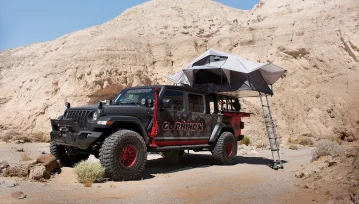
GoRhino Xtreme Rack System We know one of the major advantages of full-size rigs is the amount of gear you’re able to pack in –… Continue reading
TREAD STAFF . July 19, 2023

F Series Builders Guide
Big Daddy History Remade at Galpin When I look through old photos of Ed Roth’s F-100, I not only see hot rod and custom truck… Continue reading
Mike Self . February 23, 2026

The Sparks Show
Sevierville, TN
Goodguys 36th Autumn Get-Together
Alameda County Fairgrounds 4501 Pleasanton Avenue, Pleasanton, CA 94566
Goodguys 29th Speedway Motors Southwest Nationals
WestWorld of Scottsdale 16601 North Pima Road, Scottsdale, AZ 85260



 Please wait...
Share Link